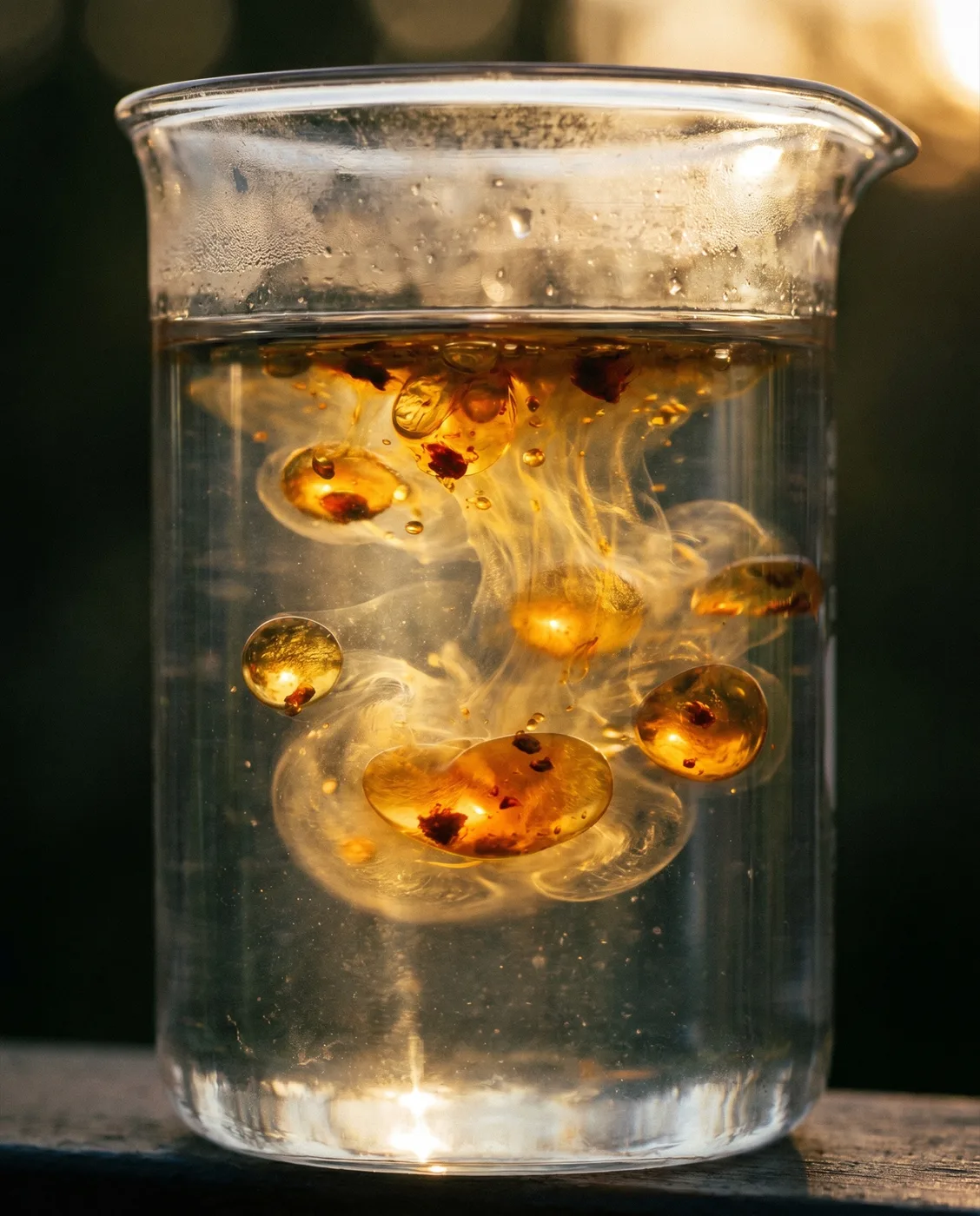
Evidence grade — Membrane-active mechanisms: SOLID in laboratory studies. Field efficacy: EMERGING — context-dependent, single study on this product. Never use pesticidal or drug claim language.
Key takeaways
- —RETURN is built on plant essential oils and organic acids — no synthetic emulsifiers, alcohols, or preservatives.
- —These compounds act on microbial outer membranes — a well-established laboratory mechanism.
- —A 2023 peer-reviewed field study supports it on potato; we treat it as one study and run our own trials.
Phytobiological technology describes a real field of agricultural science: the use of plant-derived compounds — essential oils, organic acids, terpenes, phenolics — to support plant health, soil biology, and animal wellbeing. RETURN's entire product line is built on this science. Understanding how these compounds work is the foundation of every honest claim we make.
What makes a compound phytobiological
Essential oils are concentrated volatile compounds produced by plants — oregano, thyme, clove, lemongrass, rosemary among the most studied. They are the plants' own chemical defense system, evolved over hundreds of millions of years. Organic acids (lactic, citric, formic, acetic) occur naturally in fermentation and are found throughout biology. Terpenes and phenolics are the molecular families most studied for biological activity in agricultural and veterinary science.
RETURN's formulation is built on essential oils and organic acids, without synthetic emulsifiers, alcohols, or preservatives. This is a factual composition statement — not an efficacy claim — and it is what makes the approach genuinely different from synthetic chemistry.
The membrane mechanism — how it works
The primary mode of action: disruption of a microorganism's outer membrane. Terpene compounds from oregano and thyme (thymol, carvacrol) penetrate the lipid bilayer of microbial cell membranes, disrupting the barrier that keeps the cell intact and functional. The cell loses its ability to maintain ion gradients, regulate internal chemistry, or produce energy effectively.
Organic acids act on a different target: they lower internal pH in a way that makes a microbe's interior inhospitable to the biochemical processes the microbe needs to survive. Together, these two mechanisms create what researchers call membrane-active antimicrobial activity — a well-established class of mechanisms in laboratory literature.
Crucially, these are physicochemical effects — broad-spectrum disruption of cellular membranes — rather than targeted drug mechanisms. This is why essential-oil-based compounds do not select for resistance in the same way that antibiotics, which target specific enzymes or pathways, do. (We note: the claim that essential oils cause 'no resistance' is an absolute that is not fully supported — some microbial adaptation is documented. We say resistance is less likely to develop rapidly, not impossible.)
Working with the plant — induced defense
Some terpene and phenolic compounds do more than act on microbes. In studies, they trigger the plant's own Induced Systemic Resistance (ISR) — priming the plant's immune system so it responds faster and more strongly when a pathogen arrives. The plant becomes genuinely better defended, not just externally treated.
This is the scientific basis for the claim that RETURN 'helps the plant build its own defenses.' It is mechanism-level science — established in the literature. How well it translates into field outcomes depends on crop, pathogen, conditions, and concentration, which is why we describe the mechanism and run our own trials before attaching numbers.
The fermentation dimension
RETURN's Re-New product uses plant compounds to support the biological fermentation of animal manure and compost. The mechanism: plant compounds support the microbial populations responsible for aerobic and anaerobic decomposition, helping convert waste into biologically active organic matter faster and with less methane and odor.
This closes the farm loop: crop and animal waste becomes the input that rebuilds soil biology. The chemistry of the product supports the biology of the soil. That is the one-system logic behind RETURN's product line.
The peer-reviewed field study
A 2023 peer-reviewed field study — Vasiliev, Antonov, Eremeev, APK Rossii Vol. 30 No. 1 — found that Phytogenix application in two field seasons in Chelyabinsk Oblast contributed to reduced Rhizoctonia solani and Phytophthora infestans disease pressure, and yield improvements in potato. This is the product creator-scientist's own institute, РИНЦ-indexed, on the actual product.
We cite it as: a peer-reviewed field study found that the preparation contributed to reduced fungal disease pressure and yield improvements in potato. One study, one crop, one climate. We are running RETURN's own trials before saying more.
Lower Rhizoctonia solani (black scurf) disease severity on potato.
Lower Phytophthora infestans (late blight) disease severity.
Higher tuber yield across both field seasons (2021–2022).
One peer-reviewed field study by the creator-scientist's own institute (Chelyabinsk Oblast). Directional outcomes shown; precise figures await full-text and methods verification, and RETURN is running its own trials.
Source: Vasiliev, Antonov & Eremeev. APK Rossii 2023, Vol. 30 No. 1.
Language discipline — how RETURN talks about this
Claims we make
- Based on essential oils and organic acids, without synthetic emulsifiers, alcohols, or preservatives
- Acts on microbial outer membranes — a well-established mechanism
- Designed to support plant defense mechanisms
- Supported by a 2023 peer-reviewed field study (cite with single-study hedge)
Claims we do not make
- Kills / controls / eliminates any named pathogen (FIFRA territory)
- No resistance (an absolute — say 'less likely to drive resistance')
- Nano-emulsion mechanism (not established as stated)
- Field-control guarantees without RETURN's own trial data
Sources cited
Vasiliev A.A., Antonov D.A., Eremeev A.E. APK Rossii 2023, Vol. 30 No. 1. Field trials 2021–2022, Chelyabinsk Oblast. Indexed РИНЦ / eLibrary.ru.
From science to soil
The products built on this science
Biopesticide 3-in-1
Plant protectionPlant-chemistry defence in place of a separate insecticide, fungicide, and bactericide.
Re-New
Soil & compostTurns manure and compost into living fertiliser, fast — feeding the soil microbiome.
The science is one part of the return.
RETURN is available now. If you are a farmer, distributor, or investor, we would like to hear from you.