Evidence grade — Microbial biomass support: SOLID. Diversity restoration claims: CONTESTED — do not use.
Key takeaways
- —A teaspoon of healthy soil holds billions of organisms that cycle nutrients, hold water, and suppress disease.
- —The strongest evidence supports microbial biomass — it does not support 'restoring diversity', so RETURN never claims it.
- —RETURN is designed to support this living community, not to replace it with chemistry.
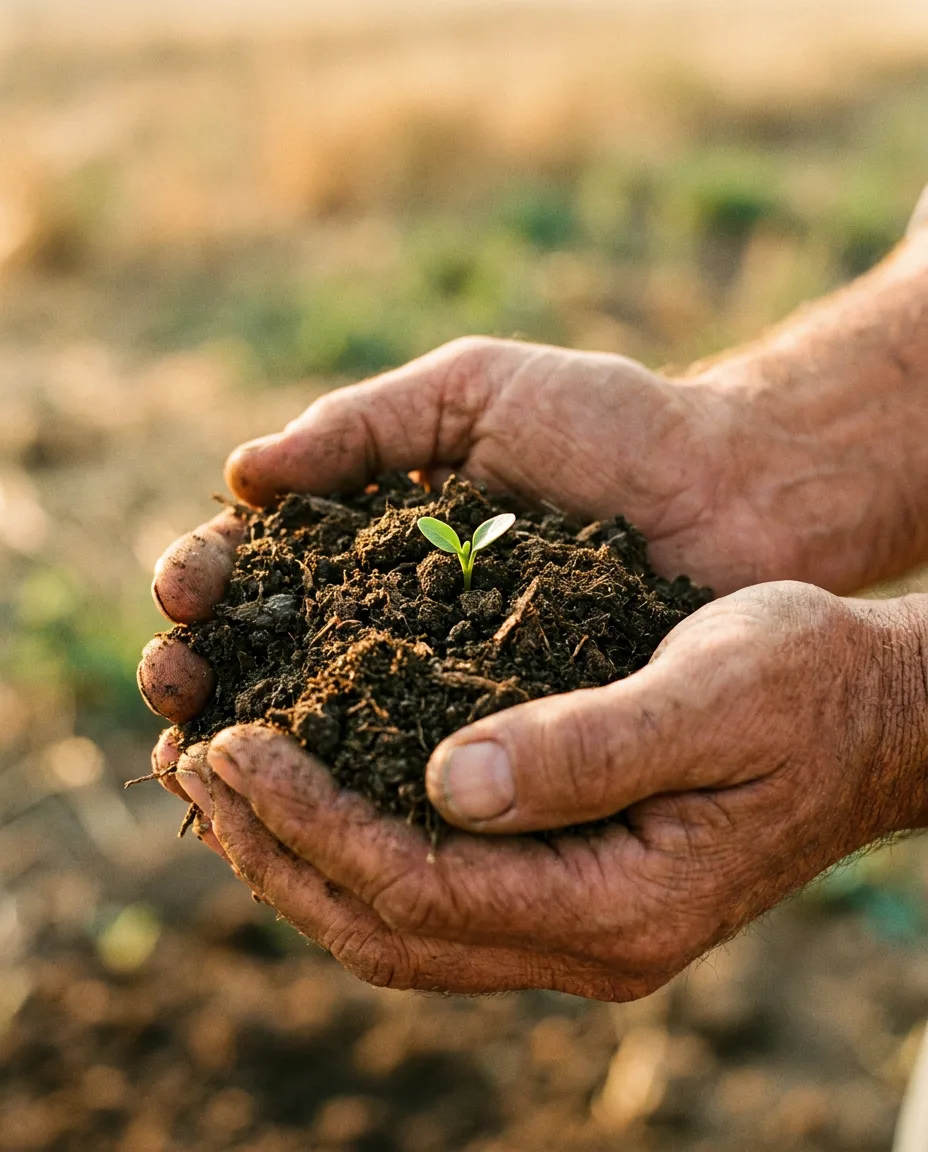
Soil is not dirt. It is the most biologically rich habitat on land — a vast, living system that runs the fertility of the planet. Understanding the microbiome beneath a field is the scientific foundation of everything RETURN does, and the most important reason why feeding crops with chemistry is not the same thing as feeding the land.
microorganisms in a single gram of healthy soil
Most species in soil have never been named. What we do understand is what they do: cycle nutrients, build structure, hold water, and crowd out disease.
Source: Frontiers in Plant Science; soil microbiology literature.
What microbes actually do
Nutrient cycling: bacteria and fungi break down organic matter into forms plants can absorb. Nitrogen fixation, phosphorus solubilisation, sulfur cycling — these are microbial services that no synthetic input fully replaces. A living soil delivers them continuously; a depleted soil requires the farmer to buy them.
Pathogen suppression: beneficial microbes compete with, outmaneuver, and in some cases directly inhibit disease-causing organisms. They occupy the same niches — the root zone, the plant surface, the soil pore space — and by filling those niches first, they leave less room for pathogens to establish.
Soil structure: fungal hyphal threads and bacterial biofilms bind soil particles into aggregates — the crumb-like structure that holds air pockets and water reserves. Lose the biology, and that structure collapses. Water runs off instead of soaking in. Roots can't penetrate. The soil becomes hard and prone to erosion.
Stress tolerance: mycorrhizal fungi extend a plant's effective root reach by orders of magnitude, accessing water and phosphorus the roots themselves cannot reach. This is the biological insurance policy a living soil provides.
The fungi–bacteria partnership
The most important relationship in the soil is not between a plant and its fertilizer. It is between a plant and its mycorrhizal fungi — a partnership approximately 450 million years old, forged before plants had roots as we know them.
The exchange: the plant trades carbon (sugars produced by photosynthesis) for phosphorus and water the fungi acquire from beyond the root zone. Both organisms get something they cannot easily obtain alone. The fungal network becomes, in effect, a second root system — and a biological information highway through which neighboring plants share signals and resources.
Intensive tillage breaks this network physically. Synthetic fungicides reduce it chemically. Rebuilding it is slow, measurable, and one of the clearest indicators of a recovering soil.
What RETURN supports — and what honest language looks like
RETURN's biological approach is designed to support the living community of the soil — to provide conditions that help soil microbial life thrive and contribute to the natural processes a healthy soil already knows how to run.
The wording matters. The strongest available meta-analysis (335 studies, Nature Ecology and Evolution 2024) found that microbial inoculants significantly increase soil microbial biomass. The same analysis found they do not consistently increase microbial diversity. That distinction is important: 'supports microbial life' is defensible; 'restores microbial diversity' is not, and RETURN will never say it.
Language discipline — how RETURN talks about this
Claims we make
- Supports the living community in the soil
- Contributes to the natural processes a healthy soil already runs
- Designed to support soil microbial biomass
- Helps provide conditions for beneficial microbial life
Claims we do not make
- Restores microbial diversity (not supported by the strongest meta-analysis)
- Increases biodiversity
- Any pesticidal or pathogen-control claim
- Guaranteed yield improvement
Sources cited
Nature Ecology & Evolution 2024 meta-analysis (n=335 studies); Frontiers in Plant Science; Rattan Lal 2020, Agronomy Journal.
From science to soil
The product built on this science
Re-New
Soil & compostTurns manure and compost into living fertiliser, fast — feeding the soil microbiome.
The science is one part of the return.
RETURN is available now. If you are a farmer, distributor, or investor, we would like to hear from you.