Evidence grade — Direction and mechanisms: SOLID. Per-field magnitude and timeframes: context-dependent, do not quantify without data.
Key takeaways
- —Roughly a third of the world's farmland is already degraded; topsoil forms over centuries and is lost in seasons.
- —Fertility is a living capacity built by biology — not a stockpile of nutrients.
- —RETURN's Re-New is designed to return biologically active organic matter to the ground and support recovery.
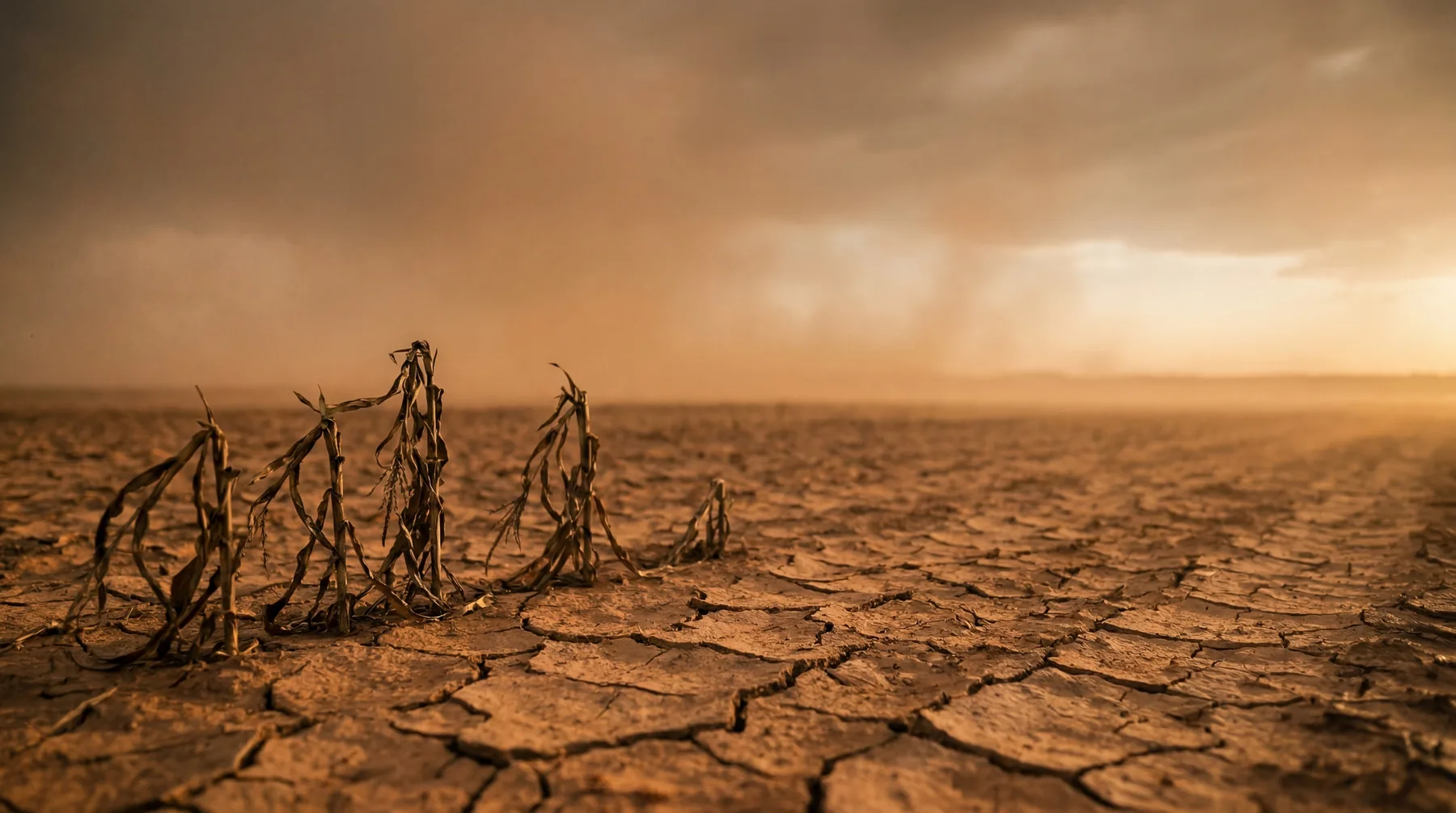
Around a third of the world's agricultural soils are already degraded. One centimeter of healthy topsoil takes between 100 and 300 years to form — and can be lost in a single season of poor management. Understanding how degradation happens, and how regeneration actually works, is the most important question facing global food security in the twenty-first century.
The scale of the problem
Approximately 33–40% of agricultural soils worldwide are now moderately or severely degraded, according to the FAO. The world loses roughly 1.5–2 million additional hectares every year. In Russia alone — which holds approximately 383 million hectares of agricultural land — around 130 million hectares are already considered degraded.
These are not abstract environmental statistics. They describe a direct reduction in the world's capacity to grow food: less water held, fewer nutrients cycled, more external inputs required to produce the same yield. The degradation treadmill speeds up while the soil runs out.
share of global agricultural soil
Roughly a third of agricultural soils worldwide are now degraded, with ~1.5–2 million hectares added every year.
Source: UNCCD Global Land Outlook 2022; FAO.
What fertility really is
Fertility is not a stockpile of nitrogen, phosphorus, and potassium in the ground. It is a living capacity — the soil's own ability to hold water, cycle nutrients, and resist erosion. That capacity is built by biology: roots, fungal threads, and microbes bind soil particles into aggregates — the stable, sponge-like crumb structure that defines a healthy soil.
Lose the biology and the structure collapses. Water no longer soaks in; it runs off. Nutrients no longer cycle; they leach. The farmer must buy from outside what the soil used to produce from within. This is the dependency the chemical model creates — and the dependency that regenerative approaches are designed to reverse.
The degradation spiral — and how to reverse it
Intensive tillage breaks soil aggregates physically, exposing stored organic matter to rapid decomposition. Bare soil between crops loses the cover that protects aggregates from rainfall impact. Synthetic chemistry reduces soil biological activity, leaving fewer organisms to rebuild what tillage destroys.
Each step makes the next harder. But the spiral runs in both directions. Increasing soil organic matter feeds the microbes that build aggregates. Aggregates hold water and air, supporting more root growth. More roots mean more OM returned to the soil. More OM means more biology. The recovery loop, once started, is self-reinforcing — but it is measured in years and decades, not seasons.
How RETURN contributes
RETURN's Re-New product is designed to accelerate the biological fermentation of animal manure and compost — converting waste into biologically active organic matter that feeds soil life faster, with less methane and less odor. This is the regeneration spiral started deliberately: organic matter in, soil life up, structure improving, water held.
We say 'helps restore' and 'supports' because regeneration is a direction of travel, not a guaranteed outcome in a single season. The science says the direction is real. The rate depends on the soil, the climate, and the whole management system. We will not promise a timeframe we cannot deliver.
Language discipline — how RETURN talks about this
Claims we make
- Helps restore soil organic matter
- Supports soil structure and water retention
- Feeds the soil's microbial life
- Designed to help return organic matter to the ground
- Supports the conditions for biological regeneration
Claims we do not make
- Specific yield figures without product trials
- Specific carbon sequestration numbers
- Restores soil in X seasons (no timeline claims without data)
- Reverses degradation (too absolute — say 'supports recovery')
Sources cited
UNCCD 2022 Global Land Outlook; Borrelli et al. 2017 (Nature Communications); FAO AQUASTAT 2025; Rattan Lal 2020, Agronomy Journal.
From science to soil
The product built on this science
Re-New
Soil & compostTurns manure and compost into living fertiliser, fast — feeding the soil microbiome.
The science is one part of the return.
RETURN is available now. If you are a farmer, distributor, or investor, we would like to hear from you.