Evidence grade — Soil as largest terrestrial carbon store: SOLID. Carbon sequestration magnitude and climate offset claims: CONTESTED — do not attach figures or make offset claims.
Key takeaways
- —Soil holds more carbon than the atmosphere and all living plants combined.
- —The agronomic benefits of organic matter are solid; carbon-offset magnitudes are contested — so we attach no figures.
- —We sell soil health, not tonnes of carbon.
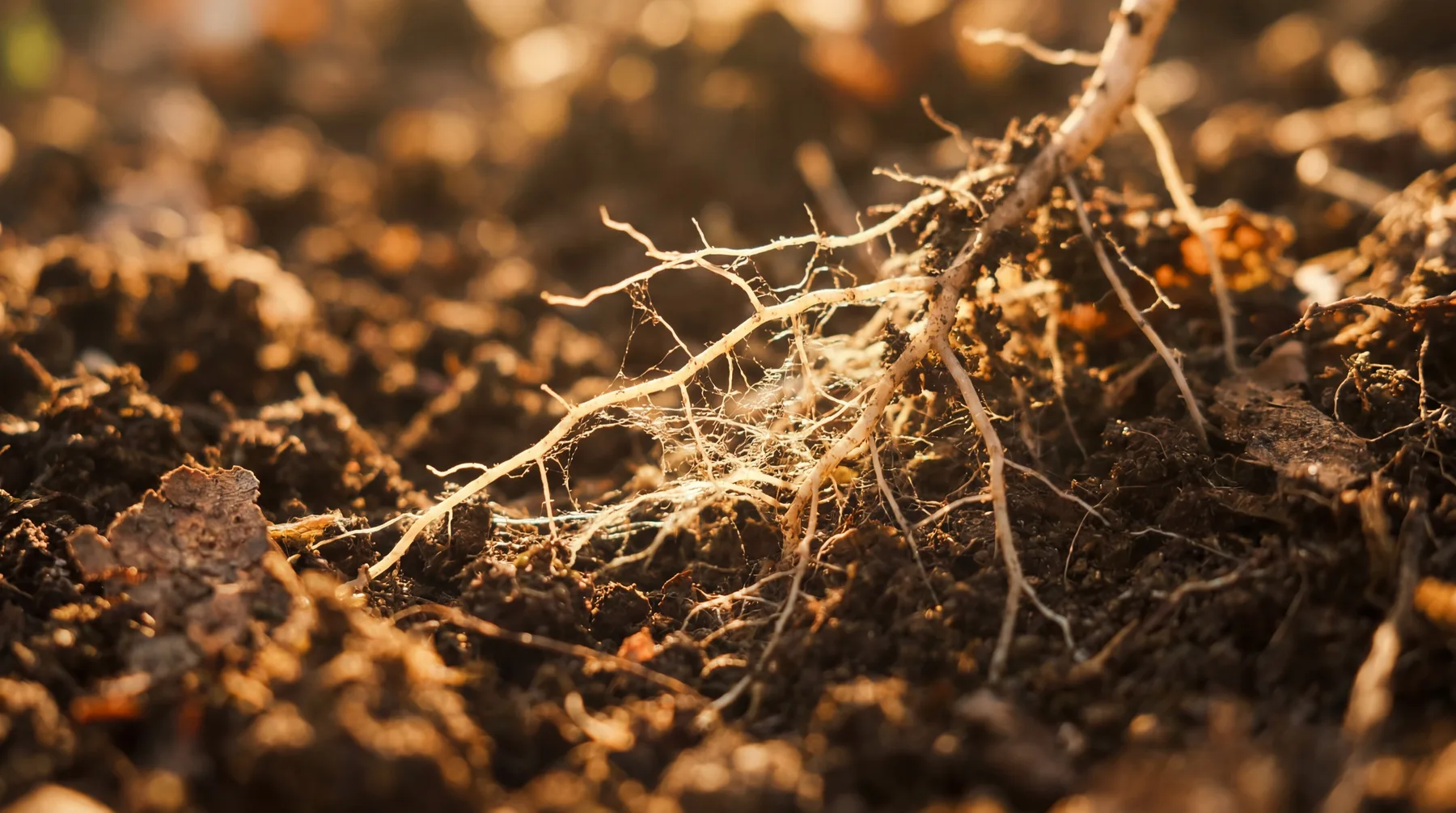
Soil organic matter and carbon are the same conversation. Building organic matter builds carbon in the soil. Losing organic matter loses carbon from it. The agronomic benefits of building organic matter — better structure, more water retained, more biological activity — are solid and measurable. The climate dimension is real. We are careful and honest about how large we say it is.
The numbers in context
Global soils contain approximately 1,500–2,400 gigatons of carbon in the top two meters — more than is stored in the atmosphere (roughly 860 Gt) and in all terrestrial vegetation (roughly 560 Gt) combined. This is established Earth-system science.
When intensive agriculture depletes soil organic matter, carbon leaves the soil and enters the atmosphere as CO₂ and methane. When management rebuilds organic matter, carbon returns to the soil. These are directional facts. The magnitude of the flux — how many tonnes per practice, per hectare, per year — is where the science is much more contested, and where RETURN will not attach numbers it has not measured.
gigatonnes of carbon (Gt C)
Building soil organic matter returns carbon to the ground. We state the direction — never a per-field sequestration figure or offset claim.
Source: IPCC AR6 Ch. 5; Rattan Lal 2020, Agronomy Journal.
Why organic matter matters beyond carbon
Soil organic matter is the single most important determinant of soil health — and most of that importance has nothing to do with carbon accounting. One gram of soil organic matter holds approximately 10–20 grams of water. It feeds the microbial communities that cycle nutrients, build soil structure, and suppress disease. It stabilizes soil aggregates against erosion. It buffers pH.
These are agronomic benefits a farmer can feel and measure in a single season. Better drainage after rain, better moisture retention during dry spells, easier cultivation, stronger crop establishment. The carbon story is the climate story. The organic matter story is the farm story. Both are real. The farm story needs less hedging.
The climate connection — what's honest
Can building soil organic matter sequester meaningful carbon at the farm scale? Yes, in direction. Adding OM adds carbon; losing OM loses carbon. This is chemically unavoidable.
Can we tell you how many tonnes your field will sequester? No — and anyone who says yes to that question with confidence is overstating the science. Sequestration rate varies by soil type, climate, starting OM percentage, crop system, and management intensity. The long-term stability of different carbon pools in the soil (some stable for centuries, some cycling within seasons) is still an active research question.
The most careful scientific literature treats soil carbon as one tool in a portfolio of climate responses — valuable, but not the headline number it is sometimes sold as. RETURN's position: we will not sell tonnes of carbon, claim to make any operation carbon-neutral, or attach a sequestration figure to our products. We will say what is true: building soil organic matter is good for the soil, and what is good for the soil is good for the carbon in it.
What RETURN does
Re-New accelerates the biological fermentation of animal manure and compost, converting waste into biologically active organic matter. That organic matter, returned to the soil, feeds the biology that builds the structure that holds the carbon.
The primary story is soil health: better structure, more water held, more biological life. The secondary story — the same process, viewed from a climate angle — is that returning organic matter to the soil returns carbon to the soil. We let both stories be true without inflating either one.
Language discipline — how RETURN talks about this
Claims we make
- Building soil organic matter supports soil structure, water retention, and biological activity
- Helps return organic matter to the ground
- Soil is the largest terrestrial carbon store — building OM supports soil's carbon-holding capacity
- Feeds the biology that builds long-term soil health
Claims we do not make
- Specific carbon sequestration figures (per ha, per tonne of product)
- Carbon-neutral or carbon-negative claims
- Offset claims of any kind
- Climate outcome guarantees
Sources cited
Rattan Lal 2020, Agronomy Journal; Sustainability 2025 (soil carbon review); IPCC AR6 Chapter 5 (soil and land-use); Poeplau & Don 2015 (meta-analysis of soil carbon changes).
From science to soil
The product built on this science
Re-New
Soil & compostTurns manure and compost into living fertiliser, fast — feeding the soil microbiome.
The science is one part of the return.
RETURN is available now. If you are a farmer, distributor, or investor, we would like to hear from you.